Fleet Programs
Fleet Manufacturing.
Integrated Execution.
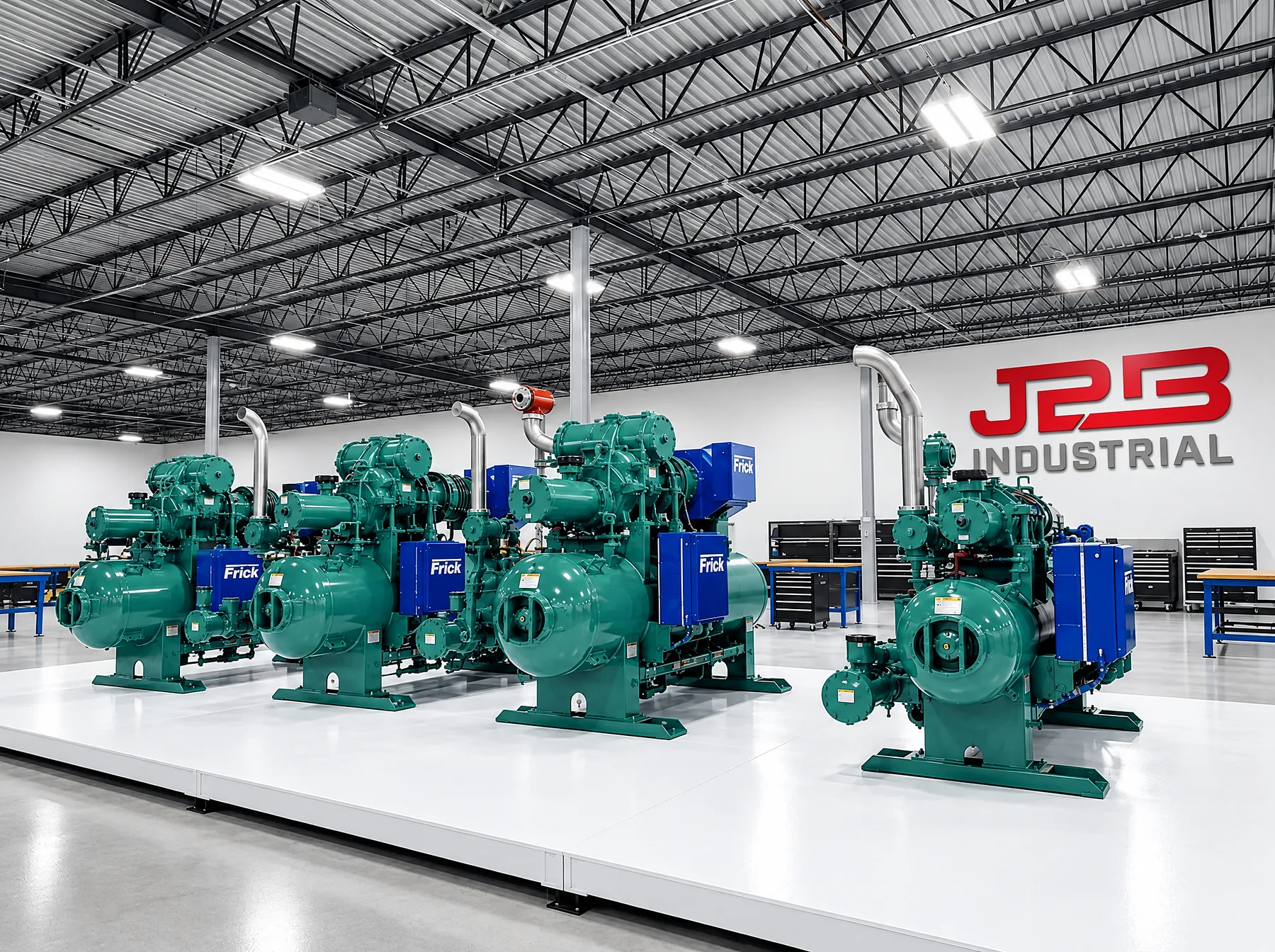
From first-unit engineering through repeatable fleet production, J2B Industrial provides integrated engineering, procurement, manufacturing, testing, and delivery for critical power-generation and balance-of-plant systems.
For strategic programs, J2B can dedicate production floor space, labor, equipment, engineering resources and procurement capacity around the customer's deployment schedule.
Engineering, procurement, fabrication and manufacturing move in parallel to compress schedule, and units ship in the order the sites need them.
Built into every fleet program
Standardization, capacity and delivery planned together, from the first unit to the last.
Fleet standardization
One configuration engineered for repetition and applied across every unit in the fleet.
Design optimization
Designs refined for manufacturability, maintenance access and repeatability before they are frozen.
Common platform development
A common platform that adapts to site and turbine variations without re-engineering the package.
Long-lead procurement
Long-lead equipment and materials identified early and placed for the block.
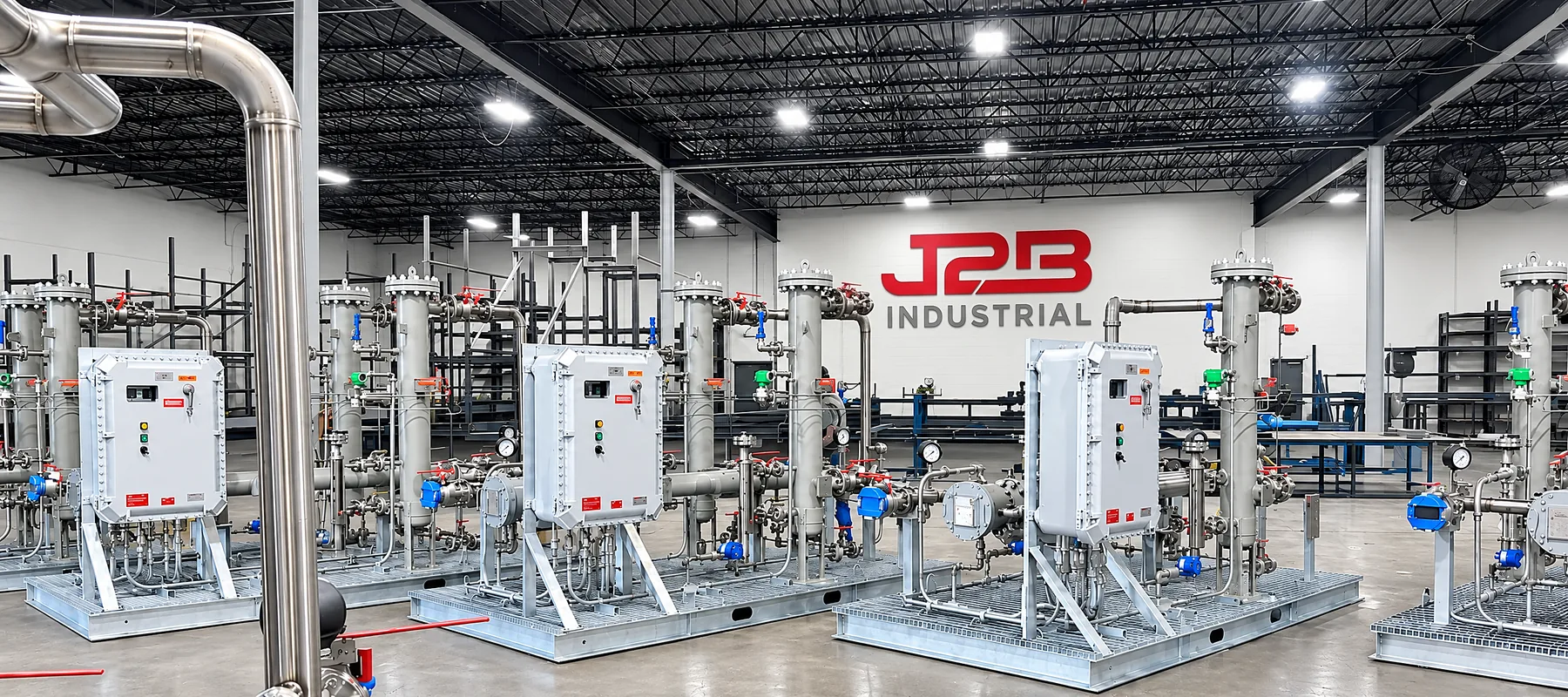
Dedicated production floor space
Floor space reserved for the program and laid out around its configuration.
Dedicated manufacturing cells
Cells set up for the program, with fixtures and tooling built for its configuration.
Reserved labor and equipment capacity
Crews and equipment committed to the program's build rate.
Repeatable production cadence
Units move through the same stations in the same sequence at a planned rate.
FAT and testing
Pressure, functional and Factory Acceptance Testing on every unit before it ships.
Documentation
A Manufacturing Record Book, test records and as-built drawings for every serial number.
Scheduled fleet delivery
Units released and shipped in the order sites are ready to receive them.
Parallel execution compresses schedule.
Engineering, procurement, fabrication and manufacturing overlap, and the first article proves the design while long-lead equipment is already on order.
Illustrative sequence. Each program's schedule is set by its scope, unit count and deployment dates.
Five phases, each with an exit gate.
The program moves forward only when the gate closes. That discipline is what keeps unit fifty identical to unit one.
Engineering
Process design, equipment sizing, P&IDs, layout and controls philosophy from turbine, site and specification data.
Exit: design review and customer approvalDesign freeze
The approved configuration becomes the released baseline. Long-lead procurement is placed for the block.
Exit: released drawing baselineFirst article
Unit one is built to the baseline and put through every inspection, pressure test and a full FAT. Findings close into the design.
Exit: FAT passed, findings closedStandardization
Fixtures, weld maps, work instructions, inspection plans and procurement locked for repetition.
Exit: production readiness reviewSerial manufacturing
Identical units move through fixed stations at a planned rate and ship in the order sites need them.
Exit: shipping release per serial numberProgram sizes
| Program | How it runs |
|---|---|
| 1 to 9 units | Project-specific engineering, full inspection and test record, FAT before shipment. |
| 10 to 24 units | Design freeze after the first article. Remaining units built to the released baseline; procurement placed as a block. |
| 25 to 49 units | Dedicated fixtures and a locked build sequence. The package is run as a product with configuration control on every change. |
| 50 to 99 units | Station-based production with multiple identical skids in build at once; FAT and shipping staggered to site readiness. |
| 100+ units | Serial manufacturing with a planned build rate, release cadence and fleet-wide configuration control. |
What the owner sees
Every unit in a program is tracked by serial number, drawing revision, build station and test status.
Illustrative program view. Not customer data.
| Serial | Config | Baseline | Type | FAT | Status |
|---|---|---|---|---|---|
| J2B-FGC-0001 | Rev A | Released | First article | Passed | Shipped |
| J2B-FGC-0002 | Rev A | Released | Serial | Passed | Shipped |
| J2B-FGC-0003 | Rev A | Released | Serial | Passed | Ready to ship |
| J2B-FGC-0004 | Rev A | Released | Serial | Scheduled | FAT |
| J2B-FGC-0005 | Rev A | Released | Serial | Open | E&I integration |
| J2B-FGC-0006 | Rev A | Released | Serial | Open | Pressure test |
| J2B-FGC-0007 | Rev A | Released | Serial | Open | Welding |
| J2B-FGC-0008 | Rev A | Released | Serial | Open | Fit-up |
Configuration control
- Model
- Fuel gas conditioning skid
- Serial no.
- Assigned at start of build
- Design basis
- Released drawing revision
- Materials
- Traced to MTR and heat number
- Testing
- Hydrostatic and FAT, signed
Stainless nameplate, one per unit
Traceable by serial number
- Serial number assigned at start of build and carried on the stainless nameplate
- Pressure-retaining material traced to MTR and heat number
- Welds traced to the welder, the WPS and the examination result
- Instruments and valves recorded with calibration and verification data
- Hydrostatic and FAT results signed against the serial number
- Manufacturing Record Book issued per unit at shipping release
Rapid deployment
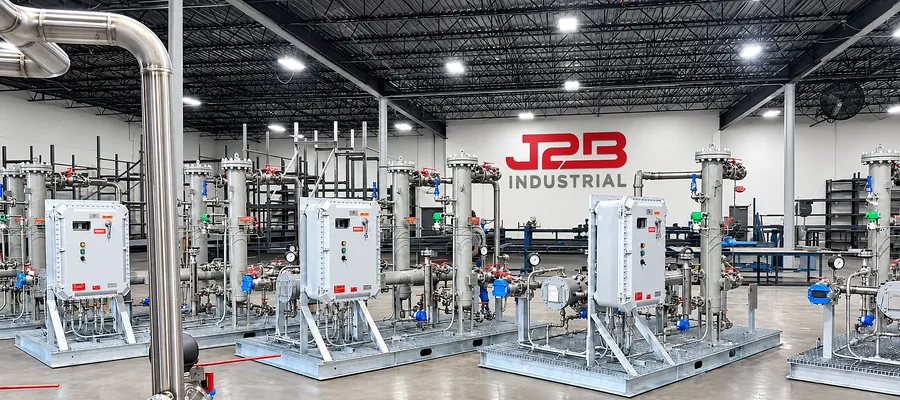
Let's build your next program.
Whether you are developing a single installation or planning a fleet deployment, J2B Industrial can work with your team to develop an engineered, manufacturable solution and establish the production capacity required to support your schedule.
Or call (904) 574-8919 · sales@j2bindustrial.com
Design basis or specification ready? Send your design basis