Glossary
Terms used across fuel gas conditioning, balance of plant, fleet manufacturing and on-site power for data centers.
- Aero-derivative gas turbine
- A gas turbine derived from an aircraft engine design, valued for fast starts and high power density. Examples include the GE Vernova LM2500 and LM6000.
- Balance of plant (BOP)
- All plant systems other than the prime mover: fuel systems, water treatment, cooling, compressed air, electrical and the piping between them.
- Behind-the-meter (BTM)
- Generation located at the load and serving it directly, often without a utility or grid operator interconnection.
- Bridge power
- On-site generation that supplies a facility until its permanent grid connection is energized.
- Cause and effect matrix
- The document that defines which inputs (causes) trigger which alarms and shutdown actions (effects) in a control and safety system.
- Configuration control
- The process that keeps a released design baseline fixed and manages every change through review, approval and assignment to specific units.
- Design freeze
- The point at which an approved design becomes the released baseline for production.
- Dew point (hydrocarbon)
- The temperature at a given pressure at which heavier hydrocarbons in a gas begin to condense into liquid.
- Dry low NOx (DLN) / Dry low emissions (DLE)
- Lean-premixed combustion systems that reduce NOx without water or steam injection, and are sensitive to fuel quality.
- Factory Acceptance Test (FAT)
- A test at the manufacturer's facility, run to an agreed procedure, that demonstrates a unit meets its design before shipment.
- Filter/coalescer
- A vessel whose elements merge fine liquid droplets into larger drops that drain out, while also capturing particulates.
- First article
- The first unit built to a released design, inspected and tested to prove the design before repeat production.
- Frame gas turbine
- A large, heavy-frame gas turbine built for utility simple cycle and combined cycle service, such as the GE Vernova 7HA or Mitsubishi Power M501J series.
- Fuel gas conditioning
- The removal of liquids and particulates from fuel gas and control of its pressure and temperature to meet a turbine's fuel specification.
- Heat number
- The identifier a mill assigns to a batch of metal, used to trace material back to its mill test report.
- Hold point
- An inspection or test beyond which work cannot proceed until the result is accepted.
- Hydrostatic test
- A pressure test using water to verify the strength and tightness of piping and vessels.
- Industrial gas turbine
- A mid-size gas turbine built for industrial power generation, cogeneration and mechanical drive, such as the Siemens Energy SGT-800 or Solar Turbines Titan 130.
- Joule-Thomson cooling
- The temperature drop of a gas as its pressure is reduced across a valve or regulator, which can cause condensation.
- Manufacturing Record Book (MRB)
- The compiled quality records for one serial-numbered unit: materials, welding, examination, tests and release.
- Mill test report (MTR)
- A certificate from the material producer stating a batch's chemical and mechanical properties.
- N+1 redundancy
- A design with one more unit than the load requires, so the load is still met if any one unit is out of service.
- Nondestructive examination (NDE)
- Inspection methods such as radiography, ultrasonic, magnetic particle and dye penetrant that find defects without damaging the part.
- Prime power
- On-site generation serving as the permanent primary source of power.
- Scrubber
- A vessel that separates free liquids and slugs from a gas stream.
- Skid
- A structural base on which equipment, piping, instruments and controls are integrated into a single transportable package.
- Slot reservation
- A paid position in a manufacturer's production queue, common for gas turbines in 2025 and 2026.
- Superheat
- The margin by which a gas's temperature exceeds its dew point, so it stays free of liquids as it cools or its pressure drops.
- Time to power
- The time from project start until usable power is available at the site.
- Welding Procedure Specification (WPS)
- A qualified written procedure that defines how a weld is made, supported by a procedure qualification record (PQR).
Let's build your next program.
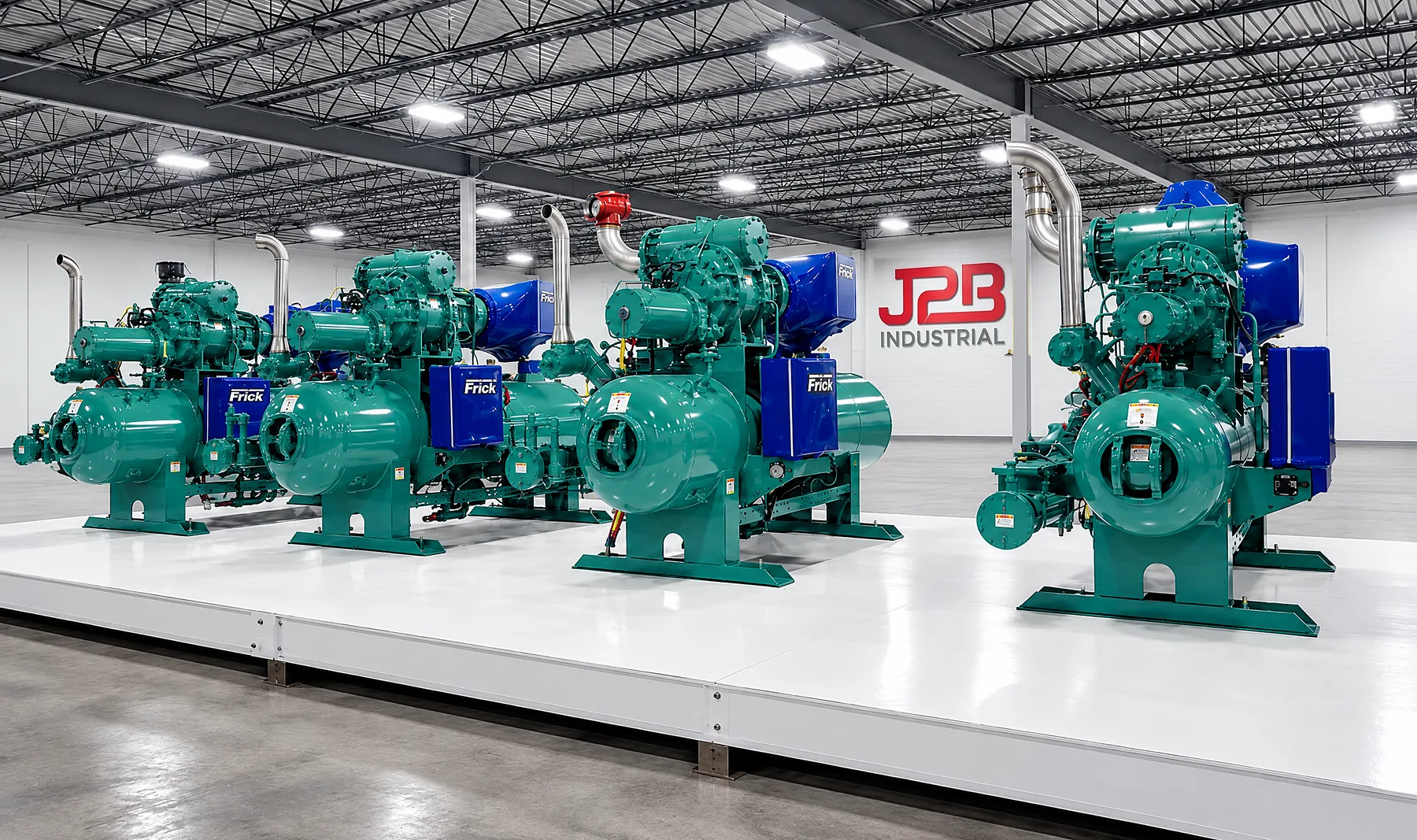
Whether you are developing a single installation or planning a fleet deployment, J2B Industrial can work with your team to develop an engineered, manufacturable solution and establish the production capacity required to support your schedule.
Or call (904) 574-8919 · sales@j2bindustrial.com
Design basis or specification ready? Send your design basis